Advances in Understanding and Treating Alzheimer’s Disease: From Pathogenesis to Novel Therapeutics and Biomarkers
Yashwanth S

Department of Pharmaceutics, KLE College of Pharmacy, KLE Academy of Higher Education and Research, Rajajinagar, Bengaluru, Karnataka, 560010, India.
Shivakumar H N
*
Department of Pharmaceutics, KLE College of Pharmacy, KLE Academy of Higher Education and Research, Rajajinagar, Bengaluru, Karnataka, 560010, India.
Arpitha N
Department of Pharmaceutics, KLE College of Pharmacy, KLE Academy of Higher Education and Research, Rajajinagar, Bengaluru, Karnataka, 560010, India.
Thimappa Bhoomika Yadav
Department of Pharmaceutics, KLE College of Pharmacy, KLE Academy of Higher Education and Research, Rajajinagar, Bengaluru, Karnataka, 560010, India.
Lakshmi Priya N S
Department of Pharmaceutics, KLE College of Pharmacy, KLE Academy of Higher Education and Research, Rajajinagar, Bengaluru, Karnataka, 560010, India.
*Author to whom correspondence should be addressed.
Abstract
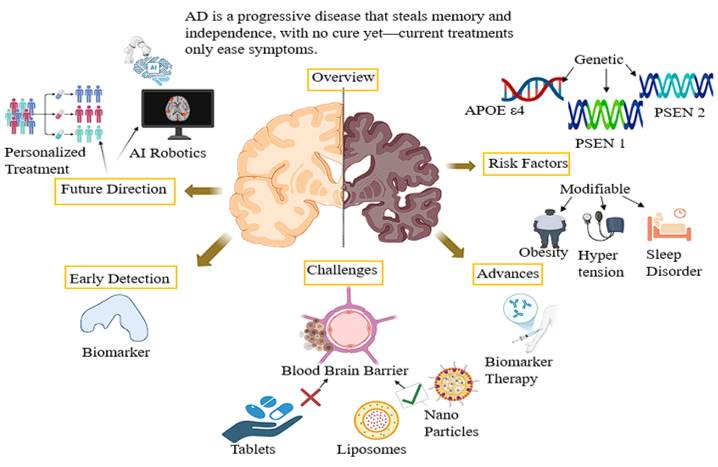
Alzheimer's disease (AD), a progressive and unrelenting memory loss, gradually weakens cognitive and independent functioning. There is currently no cure despite decades of research, and existing medicines simply alleviate symptoms. A complex interaction between hereditary variables (APOE ε4, PSEN1, PSEN2) and controllable risks (e.g., obesity, hypertension, and sleep disorders) leads to the disease. Fundamentally, tau tangles, amyloid-beta (Aβ) plaques, neuroinflammation, and mitochondrial dysfunction are what cause AD and eventually cause the death of neurons. A major obstacle in treating AD is ensuring drugs can penetrate the brain’s protective barrier. To combat this, innovative drug delivery methods include liposomes and nanoparticles, that would ensure therapeutic brain levels and reduce adverse effects are being investigated. Disease. Disease-modifying treatments, involving monoclonal antibodies such as aducanumab and lecanemab, are beginning to show promise in slowing disease progression.
Another frontier in AD management is early detection. Diagnoses can be made more quickly and accurately thanks to advanced biomarkers in blood and cerebrospinal fluid (CSF) and advanced imaging methods. Donanemab, an anti-amyloid mAB that targets amyloid plaques and has demonstrated promise in reducing cognitive deterioration, is a noteworthy advancement in the treatment of AD. Viral vectorization shows promise for Alzheimer's treatment, addressing the urgent need for better therapies due to AD's growing economic and societal impact, requiring interdisciplinary collaboration. There are still issues, though, such as late-stage detection, high drug trial failure rates, and financial limitations. Biomarker-driven therapies, tailored therapy, and advanced technology like digital health monitoring and artificial intelligence are the future of AD research. Integrating interdisciplinary work in neurology, genetics, and bioengineering brings us one step closer to turning AD from an incurable illness into a treatable one. Although there are obstacles in the way, cooperation and innovation hold out hope for a better future in the battle against Alzheimer's.
GRAPHICAL ABSTRACT
Keywords: Alzheimer's Disease (AD), tau tangles, Amyloid-Beta (Aβ) plaques, neuroinflammation, monoclonal antibodies