Regulatory, Ethical, and Legal Provisions: Integrating Positron Emission Tomography, Magnetic Resonance Imaging, Electroencephalography Data with Machine Learning for Differential Diagnosis of Neurodegenerative Disorders
Kimberly Morton Cuthrell *
School of Medicine, American University of Anguilla, United States.
*Author to whom correspondence should be addressed.
Abstract
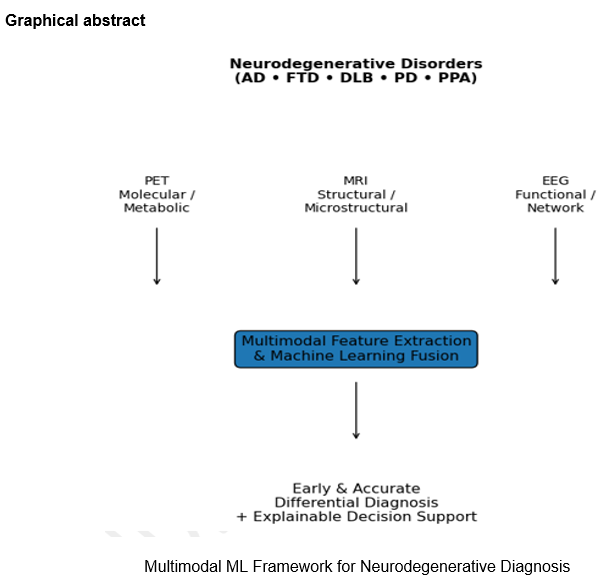
Differentially diagnosing neurodegenerative disorders is challenging due to similar appearing symptoms and various subtype mechanisms that disrupts behavioral, cognitive, and physical functions. Single modality, unimodal, biomarker types such as positron emission tomography (PET), magnetic resonance imaging (MRI), and electroencephalogram (EEG) may provide incomplete representation of neurological processes in the brain. Current evidence suggests the combined use of trimodal neuroimaging techniques (PET, MRI, EEG) and electrophysiological approaches with machine learning (ML) may generate a complete representation in the diagnosis of Alzheimer's disease, frontotemporal dementia, Dementia with Lewy bodies, Parkinson's disease, and Primary Progressive Aphasia. Classical and deep learning techniques with particular focus on data fusion methods, diagnostic accuracies, clinical applicability, and translational challenges, including the integration of tri-modal neuroimaging may expands explainability artificial intelligence (XAI) and clinical validation. Advancements in machine learning-based multimodal data with integration of tri-modal neuroimaging may leverage biologically relevance and improve early diagnosis and prognosis to differentiate subtypes of neurodegenerative disorders. Though tri-modal usage withML may yield promising results with detecting molecular specificity and visualization of neuroanatomical substrates of the brain, challenges may with limitations in dataset sizes, variations across sites, insufficient standardization, machine-learning malfunctions, interpretability issues, including obstacles with regulatory compliance, ethical, and legal provisions.
Keywords: Neurodegenerative disorders, positron emission tomography (PET), magnetic resonance imaging (MRI), electroencephalogram (EEG), machine learning, explainability artificial intelligence (XAI)